ANOTHER WAY IN
Move past identical souvenir streets. The Nordic landscape holds architectural experiments, legal exclaves, and remote settlements where human ingenuity met environmental extremes.
THE HELICAL RAMP OF RUNDETÅRN
Commissioned by the builder-king Christian IV and completed in 1642, the Round Tower (Rundetårn) combines a church (Trinitatis Church), a university library, and an astronomical observatory in one vertical complex.
Rather than stairs, visitors climb a 7.5-turn whitewashed spiral ramp (sneglegang) paved with yellow Dutch bricks. This engineering allowed heavy brass quadrants, sextants, and globes to be carried up via horseback or carriage. In 1716, Tsar Peter the Great famously rode his horse to the summit while Empress Catherine followed in a six-horse carriage.
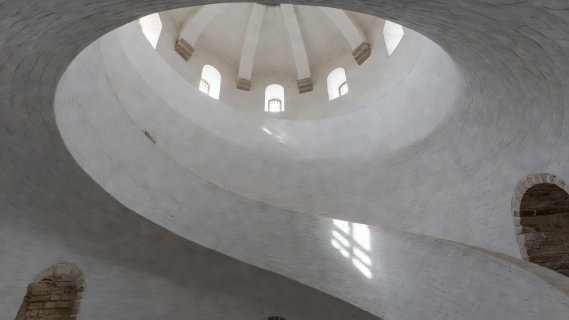 Architectural Record: 209m Helical Vault, Yellow Dutch Stave Bricks (Trinitatis Complex)
STEILNESET: MEMORIAL AT THE BARENTS SEA
Located on the windswept easternmost point of Norway, the island town of Vardø is closer to Saint Petersburg than to Oslo. In the 17th century, this tiny fishing community was the epicentre of Norway's most brutal witch trials, executing 91 people on accusations of raising Arctic sea storms.
The Steilneset Memorial consists of two structures: a 125-metre fabric cocoon designed by Swiss architect Peter Zumthor suspended in a timber scaffold, containing 91 narrow windows lit by individual lightbulbs, and an adjacent smoky glass pavilion enclosing Louise Bourgeois' installation: a burning steel chair mirrored in perpetual reflection.
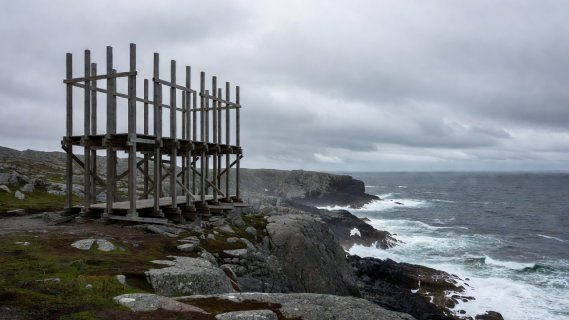 Architectural Record: Pine Post-and-Beam Scaffold over Vardøya Headland
THE DEMILITARISED ISLES OF ÅLAND
Set between Stockholm and Turku, Åland is a self-governing archipelago of 6,700 islands. While formally under Finnish sovereignty, the population is monolingually Swedish-speaking by statutory constitutional guarantee.
Following the Crimean War and the Treaty of Paris in 1856, Åland was declared a demilitarised zone—a status reaffirmed by the League of Nations in 1921. No Finnish or foreign military fortifications, uniforms, or bases are permitted on the territory, making it one of the world's longest-standing successful peace zones.
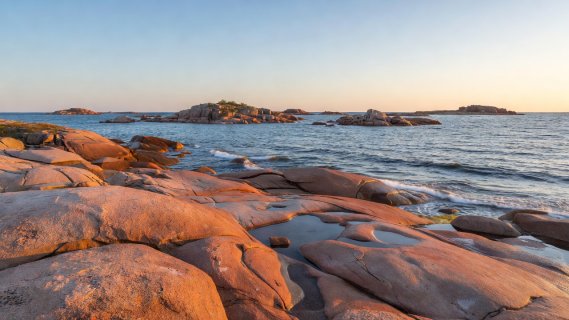 Geographic Record: Rapakivi Granite Coastal Skerries, Gulf of Bothnia
THREE OTHER GEOGRAPHICAL CURIOSITIES
Surtsey Island Exclusion Zone
Born from a submarine volcanic eruption between 1963 and 1967 south of Iceland. Declared a UNESCO World Heritage site and restricted to a handful of accredited botanists, allowing researchers to study how plant seeds and insects colonise virgin land without human contamination.
The Coal Town of Pyramiden
An abandoned Soviet mining settlement on the high-Arctic archipelago of Svalbard. Governed under the 1920 Svalbard Treaty which grants non-discriminatory commercial access. Left virtually intact since its 1998 closure, complete with the world's northernmost grand piano.
The Copper Pit of Falun (Falu Gruva)
For over a millennium, this colossal open pit in Dalarna produced two-thirds of Europe’s copper. By-products from the slag created falu rödfärg, the iconic matte red linseed-oil paint seen on rural wooden cottages across Sweden and Finland.