QUESTION THE FAMILIAR
The Northern nations have long been projected upon by outside observers. From horned helmets to eternal winter darkness, we isolate the factual record from folklore and mid-century myth-making.
THE HORNED HELMET MYTH
There is not a single archeological excavation of a Viking-age helmet that incorporates animal horns. The only near-complete Scandinavian iron helmet recovered from the Viking era—the Gjermundbu helmet discovered in 1943 near Ringerike, Norway—features an iron cap with a protective spectacled eye guard and no horn attachments.
The iconic horned helmet was invented in the 1870s by costume designer Carl Emil Doepler for Richard Wagner’s debut production of Der Ring des Nibelungen at the Bayreuth Festspielhaus. Romantic nationalism adopted the motif, which later became embedded in commercial illustration and tourist ephemera.
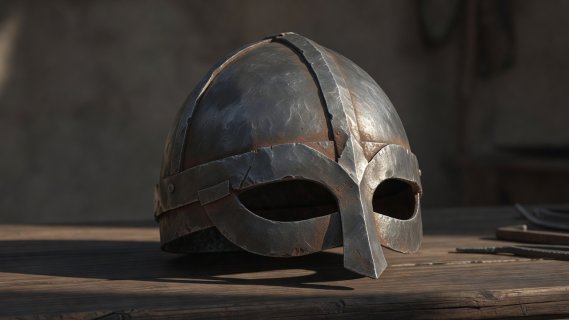 Archival Model: Gjermundbu Type Helmet, Norway (c. 950–975 CE), Clean Iron Spectacle Guard
SWEDEN’S ROYAL WAR ON COFFEE
During the 18th century, Sweden instituted five separate bans against coffee consumption. King Gustav III was so persuaded that coffee was a lethal poison that he ordered a controlled royal experiment: a convicted murderer sentenced to death was granted a commute on the condition that he drink three pots of coffee daily for life, while a second convict was given identical quantities of tea.
Both court physicians assigned to oversee the trial predeceased the subjects. The tea drinker lived to 83, and the coffee drinker survived to an even older age, thoroughly disproving the king’s clinical thesis. Today, Sweden consistently ranks among the top consumers of coffee per capita globally.
 Archival Model: Hammered Swedish Copper Kaffepanna, Tin-Lined (Dalarna Style, c. 1780)
ICE DOME VS GEOTHERMAL REALITY
International observers often imagine Denmark or southern Sweden as frozen subpolar wastes. In truth, Denmark’s average winter temperature hovers around 0°C (32°F) due to warm Atlantic currents from the Gulf Stream. By contrast, interior Lapland and northeastern Finland routinely plunge below −35°C (−31°F).
Furthermore, Denmark is exceptionally low-lying: its highest natural geographical point, Møllehøj in Jutland, rises to just 170.86 metres above sea level. This topography contrasts sharply with Norway's Galdhøpiggen, soaring to 2,469 metres above fjords carved by glacial movement.
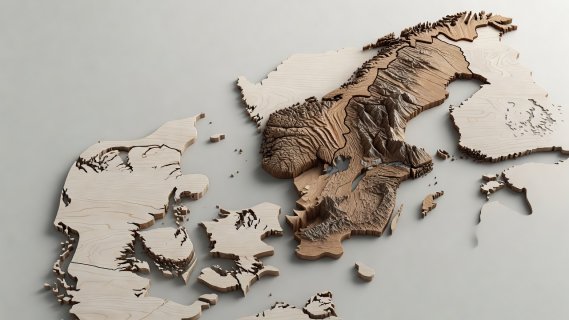 Cartographic Model: Hypsometric Elevation Disparity: Scandes Ridge vs Jutland Plain
REGIONAL DEMOGRAPHICS & LEGAL DISTINCTIONS
A quick comparative reference separating key administrative facts across the 5 independent sovereign nations:
| Country | Official Status | Language Group | Monarchy vs Republic | Schengen / EU Membership |
|---|---|---|---|---|
| Denmark | Scandinavian | North Germanic | Constitutional Monarchy | EU Member & Schengen Member |
| Norway | Scandinavian | North Germanic | Constitutional Monarchy | Non-EU (EEA) & Schengen Member |
| Sweden | Scandinavian | North Germanic | Constitutional Monarchy | EU Member & Schengen Member |
| Finland | Nordic (Non-Scandinavian) | Finno-Ugric (Uralic) | Parliamentary Republic | EU Member (Eurozone) & Schengen |
| Iceland | Nordic (Insular) | North Germanic (Insular) | Parliamentary Republic | Non-EU (EEA) & Schengen Member |